Major event strategy vs company strategy
A company strategy is built to be refined. It improves quarter by quarter, inside stable teams, with years to test an idea and drop it. A major event strategy is built for one fixed moment: a temporary organisation, borrowed people, public risk, and an opening day that does not move.
That is why the corporate format breaks when an organising committee copies it. A company strategy gives direction and lets the planning happen underneath it. An event strategy has to become the delivery structure itself, or the planning will replace it.
It happens by default, and nobody decides it.
A city wins the bid, or a federation confirms the host. An organising committee forms. Somebody needs a strategy for the board meeting in three weeks, so they open the template that already exists — the city's, the parent organisation's, the one a consultant left behind after the last planning round.
Three weeks later the event has a strategy deck. Vision, mission, four pillars, a set of measures, a slide with arrows. It is competent work. It is also written for an organisation that will still exist in five years, which the organising committee will not.
What a company strategy is built to do
A company is built to continue. That one fact shapes every corporate strategy format ever written.
Continuity buys three things. Time to test an idea and drop it. Stable teams who learn the work and stay. Risk that arrives in pieces, spread across quarters, mostly in private.
So the strategy is written as direction. It says where the business should go, and the planning happens underneath it, later, by people who will still be there next year. Getting it seventy per cent right is fine. The remaining thirty gets corrected in the next cycle.
That format works. It is just built on an assumption an event does not have.
What a major event is instead
A major event is a temporary organisation with a fixed moment of truth.
The people arrive from everywhere: the host city, the rights holder, national federations, sponsors, venues, agencies, suppliers, and eventually thousands of volunteers. Most of them have never worked together. Many report to somebody outside the committee. All of them are needed before anyone has had time to build a common way of working.
The organisation also changes shape while it works. It grows from twelve people to two hundred to several thousand, and then it stops existing. There is no next cycle to correct anything in.
And the deadline does not move. Not for a delayed venue, not for a supplier who fails, not for a decision the board could not reach in March.
Eight differences that decide the format
These are the ones that show up in the room, in the same order every time.
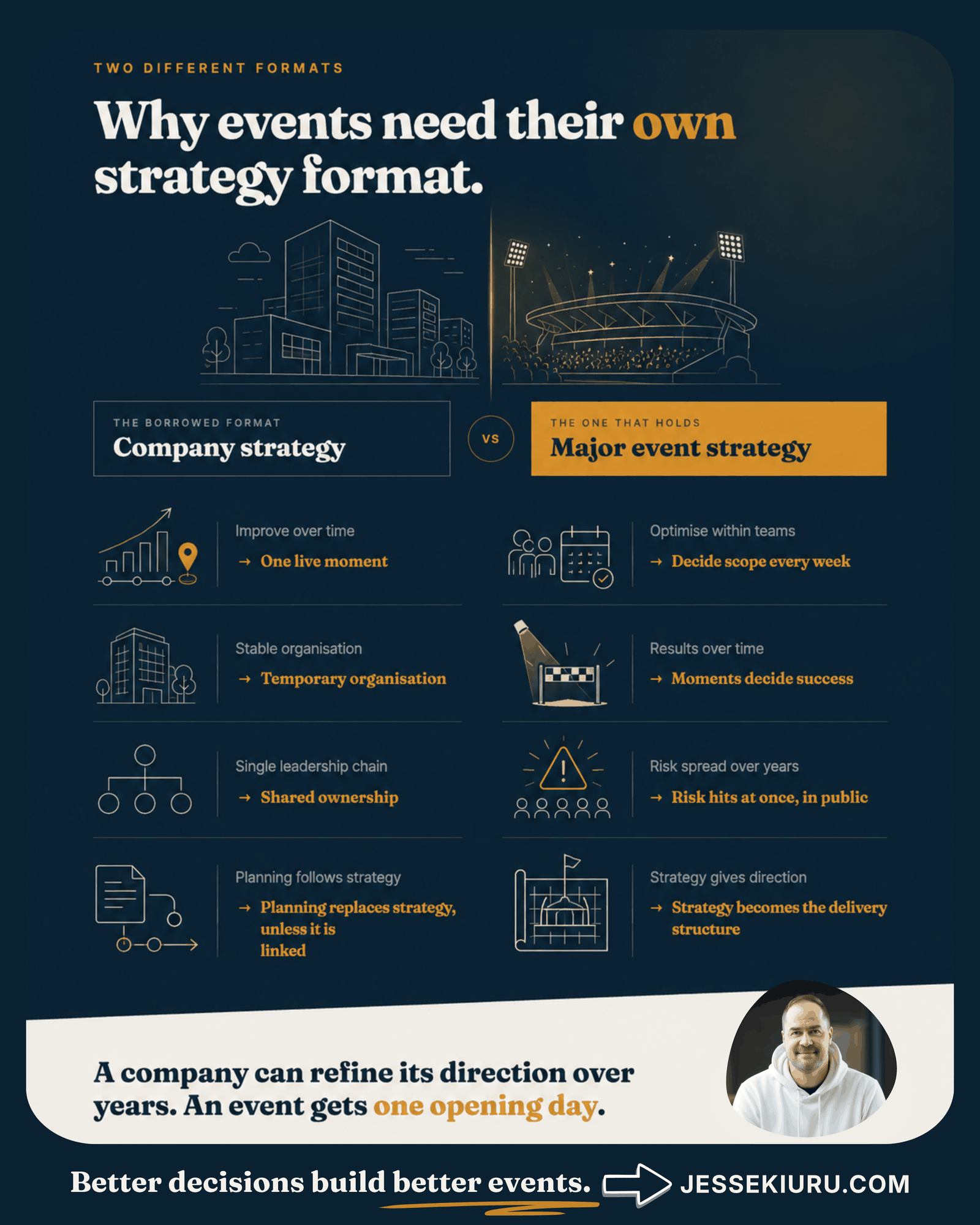
- A company improves over time. An event has one live moment. A retailer can test a layout for six months and keep the better one. An opening ceremony runs once, in front of everyone, and the version you have on the day is the version that counts.
- A company optimises inside stable teams. An event decides scope every week. The question in an organising committee is rarely how to do the work better. It is what stays in and what comes out, and that answer changes as the budget, the venues and the rights holder requirements settle.
- A company is a stable organisation. An event is a temporary one. Roles are new, reporting lines are borrowed, and half the key people are on secondment from an organisation with its own priorities. Nothing about that is fixed by an org chart.
- A company measures results over time. In an event, moments decide success. A queue at the gate, a broken timing system, a session that starts late in front of broadcast. Twelve months of good work is judged through a handful of minutes.
- A company has one leadership chain. An event has shared ownership. The city owns the streets, the rights holder owns the competition rules, the broadcaster owns the schedule, the venue owns the building. Authority is split before the first meeting.
- A company spreads risk over years. Event risk hits at once, and in public. There is no quiet quarter to absorb a bad decision. Everything lands inside the same short window, watched by media, partners and the public.
- In a company, planning follows strategy. In an event, planning replaces strategy. Unless the two are linked, department plans start first, each with its own assumptions, and the strategy quietly becomes a document that gets quoted in forewords.
- In a company, strategy gives direction. In an event, strategy has to become the delivery structure. Direction alone does not survive contact with thirty months of pressure. The strategy has to turn into named programmes, projects and owners, or it does not turn into anything.
What the borrowed format costs
The damage is not dramatic. That is the problem with it.
A corporate strategy deck gets approved, filed and referenced. Then the departments start work, because the calendar says they have to. Venue planning begins. So does transport, so does ceremonies, so does the workforce plan. Each of them needs assumptions the strategy never made concrete, so each of them makes its own.
Six months later you can see it. The same thing planned three times in different teams, with different numbers. Concepts that do not fit the budget they were built against. Outputs that are always almost ready. Nobody is idle. The event is not moving forward.
By the time it is obvious, the organisation is large enough that changing direction means unpicking work that already exists. This is the same failure I have written about as why the smartest event plans still collapse — the ideas were fine, the structure underneath could not hold them.
A company can refine its direction over years. An event gets one opening day.
The format that holds
An event strategy has to do two jobs at once. Set the direction, and hand over a structure the organisation can build on. That is why the work is a sequence, not a document.
- Vision — what should be different because the event took place.
- Mission — what drives the daily work when time is short and priorities compete.
- Strategic objectives — the vision turned into clear results.
- Values — how people decide and behave when the answer is not in a manual.
- Critical success factors — what must go right, named.
- Key performance indicators — how progress will be seen.
- Zero point — an honest view of the real starting position.
- Programme and project framework — strategy turned into organised work.
- Business model and revenue strategy — how the event creates value and income.
- Brand platform — how the event should be seen, felt and remembered.
Step eight is where the format stops being a strategy document and becomes the delivery structure. The objectives from step three and the critical success factors from step five turn into named programmes. The programmes break into projects, the projects into task groups, the task groups into tasks.
Four layers, and every piece of work links back to a purpose, a timeline and an owner. A major event carries more than 40,000 tasks by the time it opens. Without the link back up the chain, that is a list. With it, it is a plan you can read from a board meeting down to a shift on a gate.
Steps nine and ten come last for a reason. Revenue and brand both grow out of the strategy. Build them beside it and you get a commercial plan that promises things the programme cannot deliver, and a brand the organisation has to explain rather than live.
The question that exposes a borrowed strategy
You do not need an audit for this. One question does it.
Show me how this links to our objectives, timeline, and ownership.
Ask it about any active workstream. If the team can name the objective the work serves, the date it has to land, and the person who owns it, the strategy is doing its job. If the answer is a description of activity, the strategy is a document and the planning has already replaced it.
That is usually a first 100 days problem, not a strategy problem. The window to fix the format is early, while the organisation is still small enough to change direction — which is what the first 100 days after the win are actually for.
Where to start
If your event is being planned against a strategy that was written for a company, the fix is not a rewrite of the deck. It is running the sequence in order, deciding what has to be true before the next step can be answered, and stopping at step eight until the programmes are named.
The full sequence, and the three ways to run it, are set out in the 10-step strategy roadmap for major events. If your strategy is already agreed and the gap is between the strategy and the work, start instead with the programme and project planning framework.
Either way, the deadline is the same. Your event already has one. The strategy decides whether the next thirty months point at it.