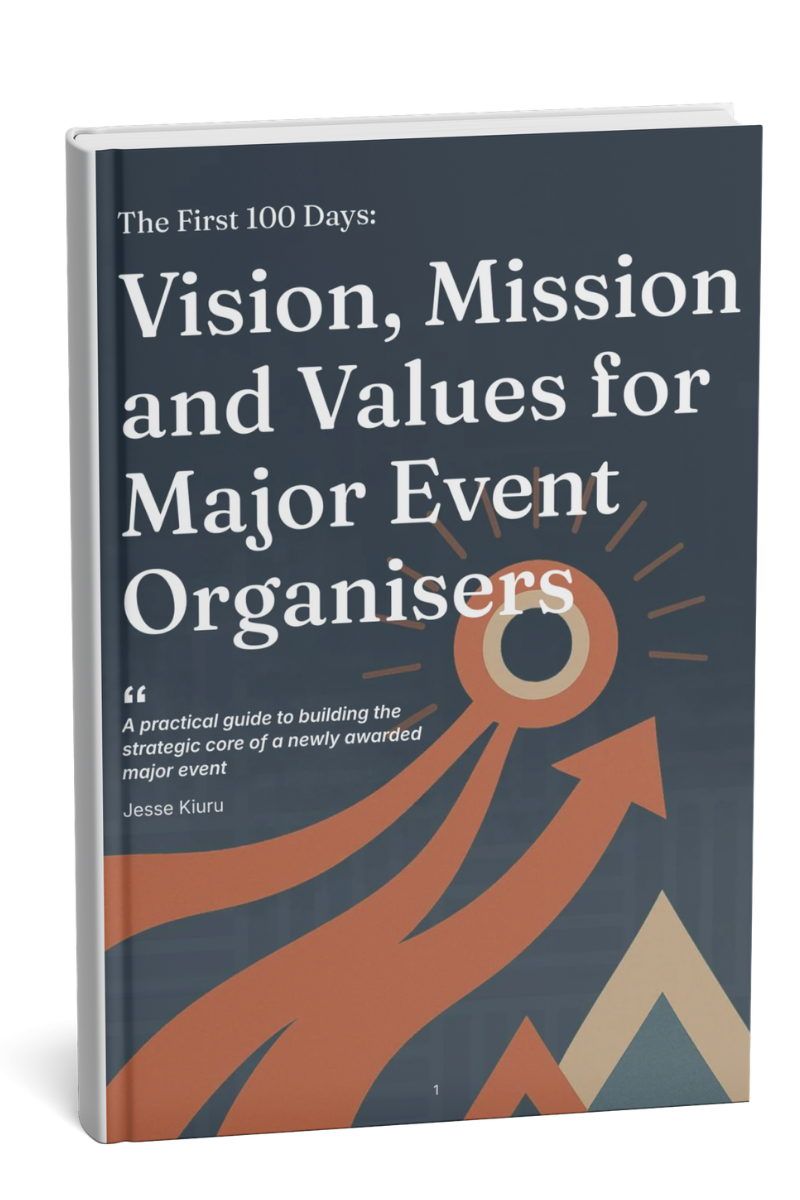
The event is awarded. The pressure has started. The strategic core is still missing. This book is how you build it before the habits harden around something else.
Steps 1 to 3 of the 10-Step Major Event Strategy Roadmap, in one sequence.
Motion is not alignment.
When a major event is awarded, everything speeds up. Meetings begin. Stakeholders want answers. Partners start asking questions. Timelines tighten.
From the outside it looks like progress.
But the board has one view. The host city has another. Commercial partners push for one kind of value. Sport leaders push for another. Delivery teams start moving without a shared language for what the event is really trying to create.
Everyone is working. The event is not moving in one direction.
That is what the first 100 days decide.
Most newly awarded events already come with a strategy trail: bid documents, host city promises, rights-holder commitments, funding expectations, legacy targets, early branding language, and informal beliefs about what success should mean.
Context first, then vision, then mission, then values, then activation. One choice at a time.
What alignment costs when it arrives late, and what “good” looks like for vision, mission and values inside a temporary organisation with a fixed deadline.
The context review that comes before the wordsmithing. What to collect, the three questions to ask of every inherited line, the ten context questions, and a five-block workshop you can run with the people who have to approve the result.
Why most event visions describe the event instead of the future. The four elements behind a strong vision, weak and strong versions side by side, and a worked example from the Winter World Masters Games 2028.
Mission as a daily operating filter, not a second vision. The five jobs a strong mission does, and how to find the work that actually matters — with examples from a multisport games, an urban marathon and a cultural year.
Why value words fail at word level. The three parts of a real value: headline, practical meaning, visible behaviour. Starting from behaviour instead of adjectives, and naming what the team will not tolerate.
Turning three statements into a working filter for meetings, planning choices, partner alignment, project prioritisation and communication. A meeting discipline, a 30/30/40 rhythm, and what to do when there is tension.
Three checks you can run on your own strategic core: the Alignment Check, the First 100 Days Activation Check, and the Review Questions. Plus the six mistakes that come after vision, mission and values are defined.
The book does not stop at writing the statements. Chapter 6 turns them into a filter for meetings, planning choices, partner alignment, project prioritisation and communication.
Still deciding whether to bid at all? Start with Before the Bid instead.
It is not a branding exercise. It is not a workshop deck. It is not a collection of inspiring statements to put on a wall.
Inspire. Persuade. Unite supporters. Satisfy the rights holder. Support political approval. Unlock funding. Create public confidence. That language already did its work.
Vision, mission and values are the strategic core. They are not the whole strategy. Each step gives shape to the next.
A book. 86 pages, seven chapters, with three bonus tools you can run as checks on your own strategic core. If you want editable templates and workshop prompts for a single roadmap step, the Vision, Mission and Values strategy guides do that job.
That is the situation the book is written for. A line that helped win the event is not automatically sharp enough to run the event. Chapter 2 gives a structured way to decide what carries forward from the bid phase, what needs sharpening, and what should be dropped.
The strategy guides take one roadmap step each and give you a framework, prompts and an editable template. This book covers steps 1 to 3 as one connected sequence and shows how vision, mission and values work together as a decision filter in meetings, planning and partner conversations. Read the book first, then use a guide when you want to build one step properly.
Instant PDF download after checkout. The price is 99 € + VAT.
The first 100 days create habits. If the strategic core is not used early, another system takes its place — built from urgency, personalities and inherited assumptions.