Home / Books & Blueprints / The Blueprint book
Book · 155 pages · PDF

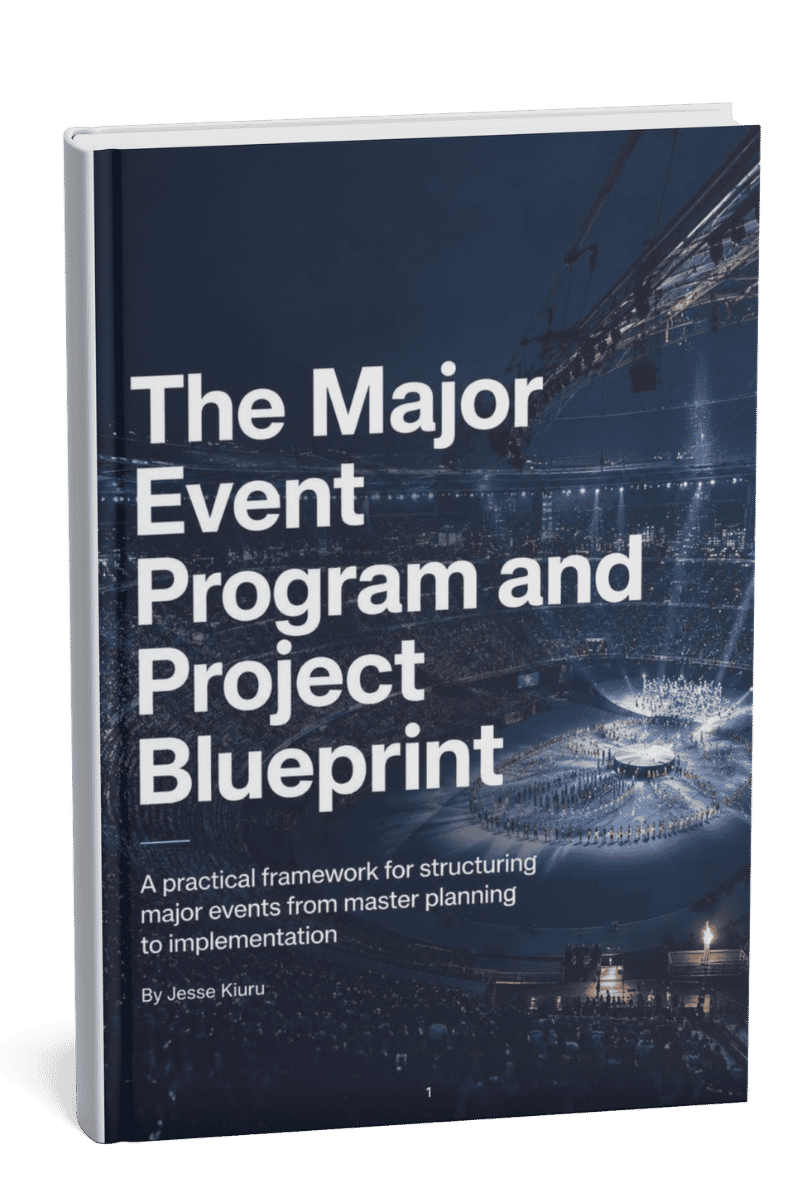
The Major Event Program & Project Blueprint

A practical framework for structuring major events from master planning to implementation. Programmes, projects, task groups, tasks — one connected planning system instead of a pile of lists.

Step 8 of the 10-Step Major Event Strategy Roadmap.

99 € + VAT · instant PDF download
The Major Event Program and Project Blueprint, by Jesse Kiuru
40programmes
400projects
4,000task groups
40,000tasks
The problem

Busy is not the same as structured.

Most organisers begin the same way. They open spreadsheets. They build schedules. They draft organograms. They start lists, open shared folders, create meeting routines, and ask every team to send actions.

All of that feels productive. Sometimes it is productive. But it does not automatically create a planning structure.

The organiser becomes busy, but not clear. People work hard, but not always in the same direction. Important work sits next to minor work with no real logic behind it. Leadership gets updates, but not a clear view of the whole.

That is not a people problem first. It is a structure problem first.

A schedule does not tell you what work belongs where. A task list does not tell you whether something has the right owner. An organogram does not tell you how the event should be broken into manageable pieces. A folder structure does not tell you what is missing.
The framework

Four connected layers, not four separate tools.

Each layer does a different job. Each layer depends on the one above it. And each layer makes the next one possible. Skip one and the work below it becomes harder to lead.

ProgrammesThe map of the event. Big enough to matter, clear enough to own.
ProjectsDefined work with a deliverable, a purpose and an owner. Structure becomes direction.
Task groupsLogical bundles inside a project. Direction becomes coordination.
TasksA specific action, one owner, one deadline. Coordination becomes action.

Strong event plans are not built from the bottom up by collecting thousands of tasks and hoping the structure appears later. They are built from the top down and then carried through to action.

A task is only truly useful when it belongs somewhere. If it does not sit inside a task group, project and programme, it is a floating action — and floating actions create confusion, duplication and missed dependencies.

What is inside

Eight lessons and a closing chapter.

155 pages. Each lesson takes one part of the planning problem and ends somewhere you can use the same week.

1
Breaking Down the Big Puzzle of Major Events

How to simplify 40,000 tasks into manageable layers without losing the big picture. The four connected levels, what each one does, and what breaks when a layer is missing.

2
The Logic of Major Event Organisers’ Tasks

Why strong event plans are built from the top down and then carried through to action — and why a task that does not sit inside a task group, project and programme becomes a floating action.

3
The Critical Questions That Shape Strong Program Planning

Purpose, audience, ownership and structure. The questions that decide whether a piece of work is properly defined before anyone starts building it.

4
The Critical Questions That Make Program Planning Work

Resources, outcomes, value, timing and measurement. The second half of the test, and the point where planning stops being a naming exercise.

5
The Killer Logic for Program Planning Work

Idea → Input → Output → Outcome → Value. The thinking model that runs through every layer and turns a planning structure into a working system.

6
Prioritising the Tasks of Any Major Event

How to decide what deserves time, money and effort when the list is longer than the organisation can carry — and how to make the no understandable.

7
How To Approach Organisational Topics of Major Events

Turning organisational subjects into planning containers with an objective, a lead, key components, milestones and a place on the timeline.

8
The Complete List of 37 Essential Programs

The benchmark. 37 programmes in five families, each with its objective, ownership, components and role in the wider structure. Use it to find what your event is missing.

Closing Chapter: From Framework to Action

How to move from the model on the page to a working planning sheet the organisation actually uses.

Lesson 5

The logic that runs through every layer.

A framework can still become mechanical. A project can still be busy but weak. A team can still work hard on something that never connects to real value. This is the test that catches it.

Idea Input Output Outcome Value
WHY WHAT HOW SO WHAT THEN WHAT

A committee may have named the programme, defined the project, assigned an owner, opened the tracker and booked the meetings — and still not be clear on why the work exists or what value it should leave behind. That is the difference between a checklist and a blueprint.

Lesson 8

The benchmark: 37 essential programmes in five families.

A major event can look well planned and still be missing a whole programme area. The problem rarely shows early. It shows later as unclear ownership, hidden dependencies, missing budgets, weak stakeholder handling and reactive problem-solving close to delivery.

A. Strategic & GovernanceTransition from bid to organising, LOC governance, decision rights, coordination.
B. Infrastructure & OperationsVenues, logistics, services and the operational backbone of the event.
C. Sport & CompetitionCompetition delivery, sport services and the field of play.
D. Marketing, Commercial & MediaRevenue, partnerships, communication and media operations.
E. Engagement & ExperienceParticipants, spectators, volunteers, host community and the experience layer.
This is a benchmark list, not a copy-and-paste model. Use it to test the completeness of your own event structure.
Who this is for

Leaders who have to hold the whole event in one view.

CEOs and Secretary Generals Event directors Programme and project leads Heads of planning and PMO Organising committees built from scratch Host cities delivering an event rarely
  • Break your event into programmes, projects, task groups and tasks that actually connect
  • Test any piece of work against nine questions before it enters the plan
  • Apply the Idea → Value logic to a programme, a project or a single task
  • Prioritise when the list is longer than the organisation can carry
  • Build a programme entry with an objective, a lead, milestones and a place on the timeline
  • Benchmark your structure against the 37 and find the gaps before they become surprises
  • What work belongs where?
  • Does this have the right owner?
  • What is missing from our structure?
  • Show me how this links to our objectives, timeline and ownership.
Where it sits

Strategy first, then structure.

Before this book

The First 100 Days builds the strategic core — vision, mission and values. Steps 1 to 3 of the roadmap. That is what the structure is supposed to serve.

This book is step 8: programme and project framework
Read it and apply the method internally
Or build the structure with your team in a one-day workshop
Or have the full framework built around your event

The workshop and advisory routes are on the Programme & Project Planning Blueprint page. This page is the book.

Who wrote this

Jesse Kiuru

Jesse Kiuru, major event strategist

25+ years in events. Last major event in charge: the Lahti 2017 Nordic World Ski Championships — 270,000 spectators, 3,000 workforce, 11 days.

Current work includes the IMGA Winter World Masters Games 2028 and the Nordic World Ski Championships 2029.

The framework in this book is the one used on those events, not a model borrowed from general project management.

Questions

Before you buy

How is the book different from the Blueprint page on this site?

The Blueprint page describes three levels of support: learning the method, running a one-day planning workshop, or building the framework together. This page is the book itself — 155 pages you can read and apply internally, without a workshop or an advisor.

Can project management software do this instead?

Software tracks work well. It does not tell you what should become a programme, what belongs inside a project, or who owns each level. Those are structural decisions and they come first. Once the structure is right, Notion, Excel, a PMO system or the Bonacube App all become easier to use. The structure travels; the software is replaceable.

Is the list of 37 programmes a template we copy?

No. It is a benchmark list, not a fixed recipe. Some events combine several of the 37, large events split them further. The point is to test the completeness of your own event structure and find what is missing before it becomes a late surprise.

Should I read this before or after The First 100 Days?

After. The First 100 Days builds the strategic core — vision, mission and values. The Blueprint is step 8 of the roadmap: how that strategy becomes an organised structure of programmes, projects, task groups and tasks.

How do I get the book?

Instant PDF download after checkout. The price is 99 € + VAT.

Structure before the work grows

Give the work a structure it can actually carry.

The earlier the structure exists, the less rework the organisation carries for the rest of the project.

155 pages · PDF · 99 € + VAT · instant download