The five kinds of event work
A major event carries more than 40,000 tasks by the time it opens. Every one of them is one of five kinds of work: leadership, management, production, experience or commercial.
The order is the sequence the event is built in. Decide the right things. Do them right. Make it real. Make it felt. Make it pay. Each kind fails in its own way, so each kind needs a different person watching it.
A task with no named kind has nobody watching for its failure. That is where delay comes from — not from unclear tasks, but from unclaimed ones.
Open any major event plan and you get a list. Thousands of rows, hundreds of owners, dates that move.
Nobody can hold that in their head, so people stop trying. They work their own section and trust that somebody is watching the rest.
But you do not have to hold thousands of tasks. You have to hold five baskets. Every task in the plan goes into one of them.
Why a task list on its own tells you nothing
A well-written task has a name, a date and an owner. What it usually does not have is a kind.
Two rows sitting next to each other can look identical and fail in completely different ways. "Agree the venue layout" and "Agree the legacy commitment with the city" are both tasks with a name, a date and a person. One fails on the day, loudly, in front of a crowd. The other fails four years later, quietly, when somebody asks what the event actually left behind.
Same format, different risk. And you only see the difference once the kind of work has been named.
The five kinds
- Leadership — doing the right things. Direction, purpose, legacy. What the event exists for and what it will refuse to do. This is quiet work. You do not notice it while it is happening. You notice it when it is missing, usually as an argument about priorities that nobody can settle.
- Management — doing things right. Budgets, plans, risks, reporting, decisions logged and followed up. The internal engine. Nobody outside the organisation ever sees it, and everything else runs on it.
- Production — making it real. Venues, power, logistics, builds, rehearsals. The work that turns a plan into a place people can stand in. When production fails, it fails in public and it fails on the day.
- Experience — making it felt. The moments people remember, and the ones they do not. Arrival, flow, atmosphere, the last five minutes before they leave. Experience does not usually fail with an incident. It fails when people come, and go home, and do not care.
- Commercial — making it pay. Tickets, sponsors, media, partnerships. Without it you have built a great event for no one, or a great event that spends money it never brought in.
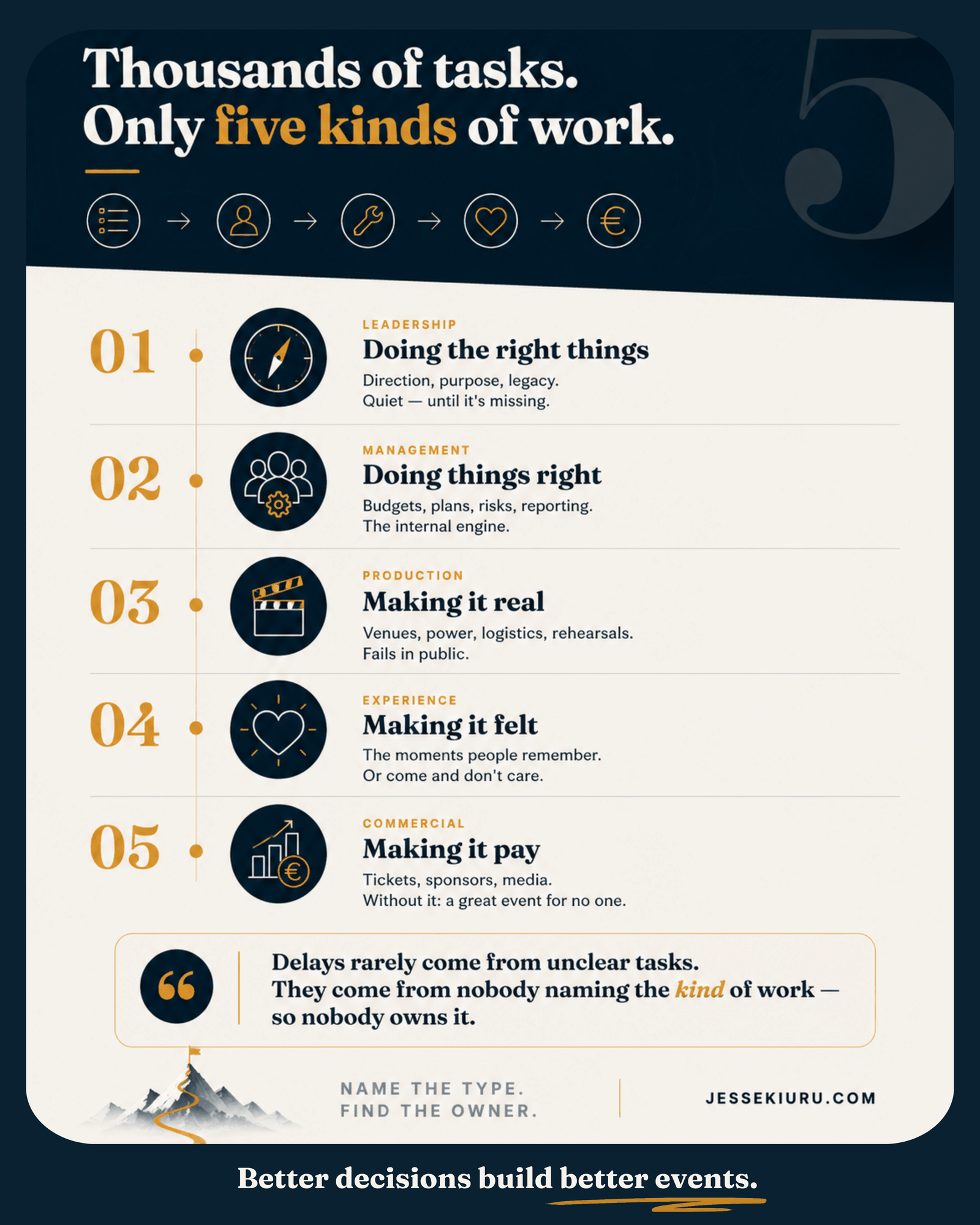
The order is not decoration
The five are a sequence, and each one depends on the one before it.
A production plan built before leadership has decided what the event is for is a plan for an event nobody has agreed on. It will be well made and it will be rebuilt.
An experience concept built before production knows what the venue can carry is a promise the site cannot keep. It gets cut in the last month, and it gets cut badly, because by then there is no time to design the replacement.
A commercial plan built before the experience is defined is selling something that does not exist yet. Sponsors buy a description. Then the event delivers a different thing, and the renewal conversation is the one nobody wants to have.
Work out of order does not disappear. It gets done twice.
Five kinds, five different ways to fail
This is the practical value of naming the kind. Each one announces its failure differently, and if you do not know which kind you are looking at, you are watching for the wrong signal.
| Kind | How it fails | When you find out |
|---|---|---|
| Leadership | Silently. No decision, so every team makes its own. | Months later, as rework |
| Management | Late. The number was wrong and looked right. | At the next board meeting |
| Production | In public. Something does not work in front of people. | On the day |
| Experience | Quietly. Nothing breaks, nothing lands either. | In the feedback, if anyone asks |
| Commercial | In the budget. The income assumed did not arrive. | Too late to replace it |
Five failure modes, five different people who should be losing sleep over them. That only works if somebody has said out loud which kind a piece of work belongs to.
A task without a named kind has nobody watching for its failure.
Why unnamed work stalls
The stalled tasks in a major event plan are rarely the unclear ones. Unclear tasks get questions. Somebody asks what it means, and the asking creates an owner.
The tasks that stall are the ones that are perfectly clear and belong to nobody in particular. They sit in the weekly report as "in progress" for six weeks. Everyone assumes another team has it, because it touches three of them and sits inside none.
Ask who owns it and you get a version of the same answer every time: we discussed it. That is what an unnamed kind of work sounds like. It is the same pattern behind what happens when everything is a priority, and it is why capable teams end up planning the same thing three times.
The fix is not a longer meeting. Name the type. Find the owner. Two steps, and the task moves.
Where the five kinds sit in the plan
The kind of work is an attribute, not a replacement for structure. It sits on top of the framework the plan is already built on.
Four layers, with every piece of work linked to a purpose, a timeline and an owner. That is what makes 40,000 tasks possible to manage at all.
- Leadership — doing the right things. Direction, purpose, legacy.
- Management — doing things right. Budgets, plans, risks, reporting.
- Production — making it real. Venues, power, logistics, rehearsals.
- Experience — making it felt. The moments people remember.
- Commercial — making it pay. Tickets, sponsors, media.
Give each programme one dominant kind. Not five, one. The moment a programme carries two, you have two accountable leaders and two different definitions of done, and the seam between them is where the work gets lost.
Projects inherit the kind of their programme. A task can differ from its parent — a production programme will contain commercial tasks — and that is fine, as long as the difference is written down rather than assumed. The full four-layer structure is set out in the programme and project planning framework.
The ten-task test
You do not need a workshop for this. Open the plan, take ten tasks, and name the kind for each one.
- They are all the same kind. The plan has a blind spot. Most committees over-index on production and management, because that work is visible and urgent, and under-invest in leadership and experience, because that work has no deadline until it is too late to do.
- You cannot name the kind for one of them. That task has no real owner. Somebody's name is in the cell, but nobody is accountable for the way it will fail.
- Two people name it differently. The ownership is split. It will stall, and it will stall politely, because both sides think the other one has it.
Ten tasks takes five minutes. It tells you more about the health of a plan than most status reports.
Where to start
Run the ten-task test this week. Then take the exercise up a level: list your programmes and give each one a single kind and a single accountable leader.
If two programmes come back with the same kind and the same leader, you have a load problem. If a kind comes back with no programme at all, you have found the work that will be discovered late — and in my experience that is almost always leadership or experience, the two that nobody escalates until the event is close.
Naming the kind is the cheapest structural fix available to an organising committee. It costs one column in the plan. It buys you an owner for every way the event can fail — which is a different problem from why capable event leadership teams still falter, but the same root cause.