Jesse KiuruMajor event strategist
Organising a new major event?
Soon someone asks for the budget, the org chart and the project plan. What will they stand on?
The bid team earned a party. A thank-you face to face, by name, means even more. Some of them go back to their day jobs next week, and half of what you need is still in their heads.
Every file goes into one shared place: the bid book, the questionnaire, the presentations, the notes from the talks. Then the promises come out of the pages. What was promised, to whom, by when. The ones made in a corridor too.
The city, the federation, the venue owners, the funders. They said yes to help you win. With the list of promises in hand, it is clear what each of them agreed to. Goodwill is never higher than it is this month, so this is the moment to get the same yes again, on paper.
The hosting agreement, the event manual, the rules, every signed deal. Page by page, the commitments come out: what is due, by when, and what it costs. The surprises that cost most later are usually already in these pages.
The organisation and its board take shape. Who has the final word on money, people and changes, and how fast? And what is the chief executive’s job, agreed before anyone starts looking for one.
What is this event, really? Who is it for, who comes, what is already there and what is not? The bid was made to win. A fresh look shows what is still true, and where you honestly start from.
What should be different because this event happened? The answer fits on one page, agreed with the city. Next to it: how you work, and how you behave when nothing is on paper.
A few goals. For each one, what has to go right, and how you will know. Eleven goals means none.
Event days. Payments. The rights holder’s deadlines. Test events. Permits. On one line, they show what everything else has to fit around.
All the work falls into groups, each with one person in charge. A first view of how the event pays for itself. A first feel for how it should look. These three start here and grow later.
You know what you promised, who decides, why the event exists and what success looks like. The next decisions come from there, with confidence.
See the checklist01The checklist
Go through it with your board. Tick what is done. Open a step to see what to do. Where the job is mostly reading, there is a prompt you can copy into the AI tool you already use.
Party held. Everyone thanked in person. The bid team stays reachable.
All bid files in one place. Every promise listed: what, to whom, by when.
I am part of a newly appointed organising committee for a major event. I am attaching our bid book, our answers to the bid questionnaire and our presentation notes. List every promise we made. For each one give: what we promised, to whom, by when, where it is written (document and page), and whether it costs money. Do not summarise. Do not skip small promises. If something is unclear, list it as a question for the bid team. Give me a table I can paste into a spreadsheet.
Each backer visited. Local agreements signed: who does what, who pays.
Every contract commitment listed, each with a date, a cost and a name.
I am attaching our hosting agreement (and any other signed contract for the event). Break it into single things we must do. For each one give: what we must do, by when, who we must ask or inform, what it is likely to cost us, and the clause number. Mark anything that needs the rights holder’s approval. Mark anything where we carry the risk if it goes wrong. Quote the clause. Do not interpret it. Give me a table I can paste into a spreadsheet.
Organisation and board in place. Agreed: who has the final word on what. The chief executive’s job on one page.
We are setting up the organising committee for a major event. Here is who is involved: [the owners, the city, the federation, the board members]. Ask me, one at a time, the questions we must answer to be clear about who decides what: money, hiring, contracts, changes to the plan, and what goes to the owners. Do not answer for me. When I have answered, put it on one page in plain words. Then draft a one-page job description for the chief executive that fits those answers.
The bid checked against today. The starting point agreed, with numbers.
I am attaching our bid book. It was made to win. Now we have to deliver. List every assumption the bid makes about visitors, income, venues, hotels, transport and public money. For each one, ask me one question that would confirm it or kill it. Do not answer for me. Then list what we would need to measure today so that, after the event, we can show what changed.
One page, agreed with the city: what changes because of this event, how we work, how we behave.
A handful of goals. For each: a name, what must go right, how you will know.
Every fixed date on one line: event days, payments, deadlines, test events.
From the attached hosting agreement, event manual and bid book, list every fixed date: event days, payments, reports, inspections, test events and deadlines for approvals. One row per date, earliest first. For each: the date, what is due, who it is due to, the source (document and clause), and what happens if we miss it. Give me a table I can paste into a spreadsheet.
All the work in groups with one person in charge of each. First outline of the money and the look.
Print it, or send this page to the person who will run the event.
Each of these will be asked for early, by someone reasonable. Done before the ten steps, they are guesses that everyone then treats as the plan.
02Why this order
The first year fills up by itself. A press conference, the hosting agreement, progress reports, site inspections, the search for a chief executive. Every task is real.
But a year in, four things are often still open:
The budget, the timeline and the org chart get built anyway. From guesses.
The event feels far away.People used to events planned in months see years ahead and relax. The same decisions just cost more later.
The team comes from the yearly event.Good people, with one habit: start from last year’s plan. This time there is no last year.
People ask for the wrong things first.Funders want a budget. The rights holder wants a timeline. The board wants an org chart.
It is nobody’s job.The board meets once a month. The chief executive is not hired yet. The first steps fall between everyone.
Don’t wait. Start the day you sign.Steps 1 to 4 and step 9 need nothing but the bid and the contracts. You already have both.
Do the right things.The ten steps are what everything else gets built from. Do them before the things people ask for.
Do them in the right order.Each step uses what the one before produced. Skip one, and the next is a guess.
Built first, every line is a guess.
Every line has a reason you can point to.
03Where it went wrong
The numbers come from public audits. My reading of all four: the work, the contracts and the money never met in one place.
Nordic World Ski Championships
Forecast, three weeks before+NOK 15.1M
Result−NOK 43.9M
Projects in one file, contracts in another, the budget in a third.Performance audit, 2026
Rugby World Cup
Planned to make+€68M
Expected result−€13.9M
Spending ran 31 % over the first budget. One director held unlimited powers.Cour des comptes, April 2025
European Games
PlannedPLN 400M
Public money spentPLN 1.7bn
Key decisions came late. The final list of sports and venues was fixed two days before the Games.Supreme Audit Office of Poland, 2025
Commonwealth Games
Contract signed onAUD 2.6bn
Spent, for no GamesAUD 589M+
The first budget was built from desk research on what earlier Games had cost.Victorian Auditor-General, March 2024
Every Olympic Games since 1960 went over budget, by 159 % on average (Oxford Olympics Study, 2024). My view after 25 years in major events: the cause is built, or skipped, in the first months.
04If you want help
You can do all ten steps yourselves. The checklist is enough to start. If you want someone who has done it before, this is what I do.
What the event is for, what it must achieve and how you will know it. A board workshop, or support over the first months.
Lahti 2029
FIS Nordic World Ski Championships
Strategy: “Place to be”
Every piece of work gets a place, one person in charge and a reason to be there. A one-day workshop, or alongside your team.
Winter World Masters Games 2028
Lahti, Heinola and Levi
Every project. Its progress. Its budget. One place. Lead hundreds of event projects from one place.
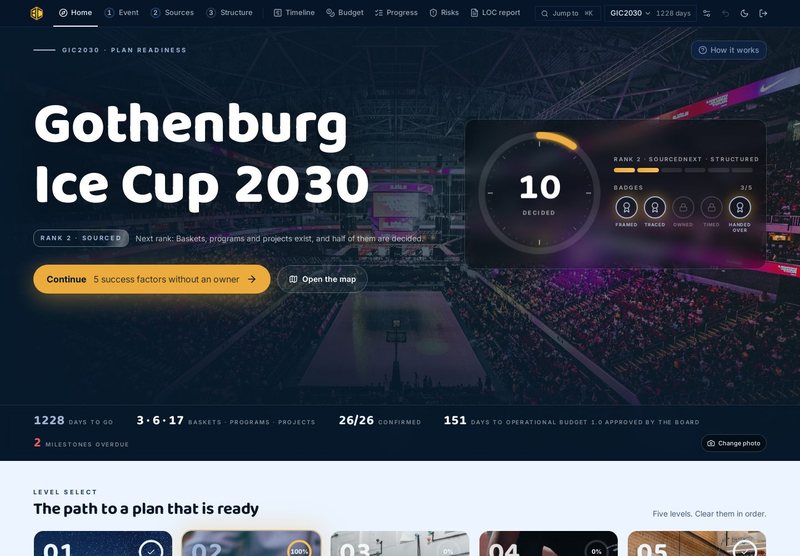
Brand new. Pricing starts at €497 a month.
05Who wrote this
I was Event Director of the Lahti 2017 FIS Nordic World Ski Championships. In the early phase we did what most events do. We moved fast, ran on goodwill and spreadsheets, and spent months later aligning things that could have been settled in the first weeks.
I have worked both sides of the table, for the host city and inside the organising company. The same steps are in use today at the Winter World Masters Games 2028 and the Lahti 2029 FIS Nordic World Ski Championships.
Twenty questions. About five minutes.
Send this to the person who will run the event. Twenty minutes with both of you is the best start. Bring the hosting agreement and the board calendar. No deck.